Showing posts with label Part 1: Introducing visual studies. Show all posts

Sunday, 26 January 2014

Leisure time and consumerism - flâneur

In this project, we are asked to make notes on the phenomenon known as flâneur, consider the impact of thinkers such as Walter Benjamin and then consider what impact this had on the artist in late 19th century. As the notes are an integral part of this project, it seems more appropriate to include them with the analysis.

Let's start with a definition, using the most used referencing site. Wikipedia defines as a literary type who strolled the streets of Paris. The term was associated with being a man (not a woman) of leisure with time on his hands, an urban explorer. The term was coined by Beaudelaire in late 19th century:

Baudelaire’s flâneur, an aesthete and dandy, wandered the streets and arcades of nineteenth-century Paris looking at and listening to the kaleidoscopic manifestations of the life of a modern city.  The flâneur’s method and the meaning of his activities were bound together, one with the other. (Seal, 2013) 

Although the concept might be thought of as no more than the perambulations of the idle rich, Victor Fournel (quoted in Wikipedia article) claimed that the art of flânerie was a way of understanding the rich variety of urban landscape, providing a moving photograph of urban experience (note 1), and the flâneur was by no means lazy. Perhaps that is self justification but it is important to remember that the city was still a relatively new phenomenon. In 1900 only London, New York, Paris and Berlin had populations of over 2m (about.com geography), and there had been none a century earlier. The idea of the city and urban life as something of academic interest was nascent.

It would appear the concept lost some of its intellectual appeal until revisited by Walter Benjamin in The Arcades Project, a massive (and incomplete) work of over 1,000 pages covering his notes of observations made when in covered arcades. Benjamin observed the phenomenon of flânerie, described by Kirsten Seale thus:

The flâneur’s movement creates anachrony: he travels urban space, the space of modernity, but is forever looking to the past. He reverts to his memory of the city and rejects the self-enunciative authority of any technically reproduced image. The photographer’s engagement with visual technology is similarly ambivalent. The photographer reiterates the trajectory of technological advance through his or her acculturation to new technologies, yet the authority of this trajectory is challenged by photography’s product: the photograph, a material memory which is only understood by looking away from the future, by reading retrospectively. (Seale, undated)

In Arcades, Benjamin introduces the dialectical concepts of Erlebnis,  loosely a description of the sensations of urban life, alluding to the senses induced by the overwhelming fast moving, busy, impersonal and wide variety of urban life, and Erfahrung, a calmer, more measured response induced by absorbing the wealth of sights by the process of flânerie. For Benjamin, the arcades offered places to reflect, maybe turn Erlebnis into Erfahrung

The importance of the concept of flânerie and its revival by Benjamin in the art world is to provide some insight into the work of artists who painted and photographed the urban scene. One painting that crops up several times is by Caillebot, depicting a scene by Place de Dublin. 
File:Gustave Caillebotte - Paris Street; Rainy Day - Google Art Project.jpg
Paris Street in Rainy Weather by Gustave Caillebot; Oil on Linen;1877.
Caillebot was influenced by photography (notice how the figures in the background become less sharp); a well known proponent of that medium started his collection of Parisian images in 1897. Eugène Atget is viewed as a founder father of photography. He was an actor and artist before turning to photography, first landscapes then images of Paris, which is what he is best known for.  
Atget Boulevard du Strasbourg Corsets, Paris 1912

Atget's observations of Parisian life have had long lasting appeal. His flânerie is exhibited by his work depicting a disappearing Paris. He typically excludes people yet "there is a powerful sense of lived lives in his work." (Badger, 2007, p56).

Conclusion

A useful and informative introduction to a phenomenon that I had not heard of before. Enjoyed reading about Walter Benjamin, think his name will crop up again in photographic studies 

Note

1. It is interesting that Fournel refers to “un daguerréotype mobile et passioné”. At that time, there were conflicting claims to who invented the camera, the French preferring their man, the English Fox Talbot. In truth they both invented it, albeit Fox Talbot's invention was more long lasting as it allowed reproduction of images.

References:

About.com geography http://geography.about.com/library/weekly/aa011201f.htm [Accessed 26 January 2014]

 Badger (2007) The Genius of Photography.  Quadrille Publishing Limited: London

Seal (2013) Baudelaire, Benjamin and the Birth of the Flâneur Available from http://psychogeographicreview.com/?p=2568 [Accessed 26 January 2014]

Seale (undated) Eye-swiping London: Iain Sinclair, Photography and the Flâneur quoted in Seal (2013, ibid)


Saturday, 25 January 2014

Photography: the new reality

For this project, we are asked to read and make notes 1920s article by Osip Brik, Photography versus Painting, then answer three questions. The notes are included as a separate post under Reading. In this post, I consider the three questions.

Do you think that Brik's article points to a practice that was taken up by photographers or other artists to any great extent?

To summarize, Brik's most important points:
  • that painters cannot hope to represent reality as well as photography - in this respect, painting is the 'horse and cart' and photography the 'automobile'.;
  • photographers have an important social role that they do not realize;
  • photographers should not seek to  "attain the social recognition of painters" but to accentuate the difference: “By battling against the aesthetic distortion of nature the photographer acquires his right  to social recognition, and not be painfully and uselessly striving to imitate models alien to photography.”       
In short, photographers should stick to the knitting and develop their craft in a distinct way.

It is important to see Brik's article in context, both in terms of its timing, and that he was Russian. The camera was developing quickly in 1920s, becoming smaller, lighter and faster to use culminating in the invention of the first 35mm camera by Leica in 1925 (Badger 2007, p68). This meant photography could more responsive to the immediacy of a situation, requiring minimal set up, and therefore ideal as a reporting medium. Russia was in throes of optimism post the Revolution; there was a perceived need to record the new socialist existence. 

For both these reasons, and, one suspects, a reaction against the perceived bourgeois nature of 'painterly art', that Opik sees photography as different, not really an art at all.

His approach was one of the strands of what has been termed 'The New Vision'  an eclectic approach adopted in Europe in 1920s (Badger 2007, p59) with the common feature of using the lightweight camera to take photographs from unusual angles, vertically and extreme close up. Of particular relevance to this article was the strand termed Russian constructivism expounded most famously by Alexander Rodchenko and El Lissitsky, both of whom, significantly, were typographers, artists and graphic designers as well as photographers.

Rodchenko declared painting dead and turned to photography - art was bourgeoisie. For him, the camera was the tool of new man (BBC, 2007) . He even wore a special uniform. He explored his constructivist ideas within the propaganda framework, such as this image of people walking to a politically approved demonstration. Perhaps ironically in view of the politicalisation of the image, it fetched £46,100 at auction (Christies 2007)


Assembling for a Demonstration, 1928
Assembling for a Demonstration,.1928 Alexander Rodchenko
El Lissitsky embraced constructivism enthusiastically. He repudiated traditional art as bourgeois and decadent, and embraced photography, typography and film which he believed would be a new art for a new age; he was the archetypal 'artisan' as opposed to 'artist' as described by Brik. Lissitisky used collage in this self portrait, where vision passes from head to hand, itself holding a compass as a symbol of the scientific basis for the new world order (Badger 2007, p59).

el lissitzky, self portrait (constructor), 1924
The Constructor, 1924 El Lissitsky
The constructivist philosophy was clearly associated with Brik's article, perhaps to the point where it may be viewed more as the cause of his essay than the result. But constructivism was just one of the manifestations of New Vision, an umbrella philosophy that was politically motivated and was inclusive of several related disciplines.

Surrealism was another manifestation of New Vision thinking. Born from the nihilistic, anarchic Dada art movement (later associated with Anti Art, thus the link with Brik's article), surrealists investigated the unconscious world (Badger 2007, p63) and were taken with photography, partly because it was perceived as an antidote to bourgeois  traditional art. Photomontage was one popular medium, this image by Hannah Höch being one of the most well renowned, containing politically overt icons questioning the Weimar republic and women's place in society:
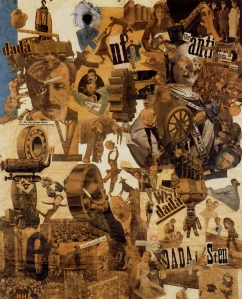
https://utopiadystopiawwi.files.wordpress.com/2013/01/hoch-knife.jpg?w=242
Cut with the Kitchn Knife, 1919, Hannah Höch
Lastly, the typological approach, the production of many photographs of the same thing, emerged in 1920s. This approach can be seen in part as the development of photography as its own discipline, simply because the production of multitudinous images was physically beyond traditional art. The photographer was thus 'acquiring his right to social recognition' to paraphrase Brik. Typology saw the emergence of the photobook, both non political as in Blossfeldt's Art Forms in Nature, an unintentional photobook resulting from Blossfeldt's work on the sculpture of living, and political, as in the images of Sander. His book Man in the Twentieth Century. Face of Time attempts to classify contemporary German society, an example being this image of young farmers, an outstanding social and psychological image that leaves the viewer questioning the activities, expressions and gestures of the subjects. It is documentary photography of the highest quality and is therefore a fine example of why photography should not seek to 'strive to imitate models alien to it' as Brik says; the image stands on its own without comparison to another art form.


In conclusion, I believe we can say that Brik's article does point to practice that was being adopted by a number of related approaches all of which were overtly political, and all of which were empowered by the improving technology of the camera. Brik was making a point - "don't worry about art, go your own way photographers" - but it was happening anyway; he hardly needed to make the point.

Do you find any resonances with Brik's ideas in contemporary discussions of photography and painting?

Contemporary discussion has tended to focus on the status of photography as an art form. Wells (2006) uses the distinction made by Williams (1976) between 'art' as a creative skill and 'Art' as fine art practices - being shown on exhibitions, galleries, museums, for example - to point out that the medium has more typically been viewed as the former than the latter. It was not until 1989 that the Royal Academy had its first ever photography exhibition. The Tate Modern's first photographic exhibition was 14 years later. In crude monetary terms, the most expensive photograph ever is Anderas Gursky's Rhine II which fetched £2.7m in 2011; comparing that to the $58.4m that Ballon Dog: Orange was sold for two years later (as per previous post) provides an indication of the respect of relative merit of the two artistic media. 

Howells and Negreiros discuss the argument of Roger Scruton at length. Scruton's view is uncompromising: there is no beauty in photography except insofar as reflected in the subject - the photographer adds nothing whereas "a painting may be beautiful....even when it represents an ugly thing." (Scruton, 1984). This is surely too simplistic; given the same subject in the same place at the same time, a group of photographers will undoubtedly produce very different images whether by using skills that are familiar to painters such as composition and use of light and texture, and by using more technical skills such as experimenting with different focal lengths or focus points. The photographer can add beauty where none may be evident in the subject. 

These arguments are resonant with those of Brik but come at the central core of the debate form a different angle. Whereas Brik was all for celebrating the democratisation of art by the new more accessible medium, Scruton is scornful of photography's claim to be art because he implicitly believes photography wishes to be seen as an equal to painting. His viewpoint that celebrates High Art is entirely different to Brik's.

It seems to me that photography protests too much. Photography in an artistic sense suffers because of its very success. Everyone has a camera. To quote Walter Benjamin:

"The illiterate of the future will not be the man who cannot read the alphabet, but the one who cannot take a photograph."

This is perhaps an extreme view but it emphasises the accessibility of photography, even more so in these days of camera phones and tablet computers. If you take 500 photos on holiday, you are virtually certain of taking a few that are very good, if only because you get lucky on composition and the structure of the subject requires little technical input. But does that qualify as art? Is the photographer actually interested in whether it is art? Therein lies the crux of the problem for photography: it is used for many purposes, most of which are at best tangential to artistic motives. Photography is used in endeavours as varying as forensics, advertising, sport, and documentary; in none of these is the artistic quality the prime motivation of the photographer even though there may be artistic quality as a by product. There have been attempts to use images captured for one reason to be used as an art form - for example, Weegee used his position as a press photographer in 1940s New York to follow the emergency services and capture strong black and white images that became exhibition material - but they are the exception. The variety of uses for photography and the sheer amount of photographs taken inevitably means the boundaries will be blurred between what is photographic art and what happens to look good artistically despite being produced for a different reason. The tendency for photographers to produce photobooks or series of images as artistic works often combined with text (e.g. Short 2011, ch4) perhaps is a result of the need to differentiate the medium as an art from from one that is utilitarian. Painting has less need to consider this dialectic, there is a stronger distinction between painting as fine art and commercial art.

As a footnote look at the voting and arguments on Debate.org. As at 25 January 2014, the voting on whether photography is art is split exactly50:50. This argument evidently has a way to go.

Find and annotate two examples of images that demonstrate the impact of photography on painting

In order to carry out this exercise I performed an internet search on "images demonstrating impact of photography on painting". Some interesting links appeared of which Sozanski (1999) was one. He writes about an exhibition of artwork directly based on photographs at the Synderman Gallery in Philadelphia. Of those discussed, I selected Mobil by Peter Cain as the first image. 


Cain has taken a photograph of a day to day scene and extracted the signs, text, numerals (Sozanzki calls it 'denaturing') and translated to a painting that is now a geometric pattern of colour, an image of symbolic, semi abstract resonance. One gets a feeling of space and emptiness that would be absent from the original photograph.


The second image is The Jockey by Degas. This is an early example of the direct impact of photography on painting. Degas used photographs and reflected the gait of the horse and the action of the rider in pulling the reins back.

Conclusion

I found this project interesting and rewarding. The argument about photography's place in the art world has been raging for over a century and this project was a chance to consolidate my knowledge and thoughts on the subject, and then to look at the subject from the point of view of painting and how it has been directly impacted by photography with two examples.

References:

Badger (2007) The Genius of Photography.  Quadrille Publishing Limited: London

BBC (2007)  The Genius of Photography. DVD.

Benjamin Quotations from the World of Photography Available from http://www.photoquotes.com/showquotes.aspx?id=160 [Accessed 24 January 2014]

Christies (2007) Auction details Available from http://www.christies.com/lotfinder/photographs/alexander-rodchenko-assembling-for-a-demonstration-1928-4983498-details.aspx [Accessed 20 January 2014]


Howells and Negreiros (2012) Visual Culture. Revised 2nd ed. Cambridge: Polity Press


Scruton (1984) The Aesthetic Understanding Methuen: London cited in Howells and Negreiros (2012) 
  Short (2011) Creative Photography Context and Narrative AVA Publishing: Lausanne

Sozanski (1999) Assessing Photography's Impact On Painting Available from http://articles.philly.com/1999-03-12/entertainment/25511640_1_painting-photorealist-photographs [Accessed 25 January 2014]

Wells (2006) On and beyond the white walls Photography as art In Photography: A Crtical Introduction Third Editon Routledge: Oxon

Williams (1976) Keywords London:Fontana cited in Wells (2006) 

Monday, 20 January 2014

Osip Brik ‘Photography versus painting’


Opening sentences: “Photography pushes painting aside. Painting resists and is determined not to capitulate.”

Photographers’ motto: precision, speed, cheapness.

Photography is no coloured (written in 1920s). Painting can give a picture colours but approximate so the defence of painters is that ‘precision is not the ultimate aim’ (perhaps this misunderstanding of what art aims to do underlies Brik’s thesis). It is the painter’s ‘duty to change reality otherwise he is not a painter but a bad copyist. 

‘Life cannot be represented in painting....[but]  must be recreated on canvas in a separate, painterly way.” Hence rise of Impressionism, Cubism and related schools.

Brik sees that contemporary Russia needs a visual record of the new (socialist) life and in the absence of sufficient photographic resource, what Brik terms ‘painterly realism’ is resurrected; a hopeless task in his view, akin to using a horse and cart instead of an automobile.

Brik scolds photographers for not realizing their social importance: “they think they are only artisans, humble workers far removed from artists and painters”. Hence photographers strive for painterly effects in order to attain the social recognition of painters. Brik views this goal as mistaken, indeed the photographers should accentuate the differences between the arts. “By battling against the aesthetic distortion of nature the photographer acquires his right to social recognition, and not be painfully and uselessly striving to imitate models alien to photography.” We need a new art of photography independent of the laws of painting. Example is Rodchenko.

Saturday, 18 January 2014

Art as a commodity

Having read Marx's article The Fetishism of the Commodity and made notes under the label Learning Noteswe are asked four questions:

Can you see ways in which this may help us to understand the art market?
 
In simple terms, definitely. Art is a commodity with modest use value, however much labour is invested therein. It has decorative uses, and, before the advent of the camera, was the source of portraiture but little use value besides. Furthermore, the value of paintings is a great deal more than the sum of the materials used, so there is indeed an "enigmatical character of the product of labour" (Marx, 1867) Moreover, to an untrained (and sometimes trained) eye, one Old Master is very much the same as another. Valuing art is therefore very much about the perception of the artist as opposed to the product, for example why a Rembrandt painting is worth hundreds of times more than one from a less well known painter. This explains why the process of attribution (actually working out who painted a work) by art historians is so important. Howells and Negreiros point out that a suspiciously large number of paintings have been attributed to Rembrandt and quote the example of one - Man Wearing a Gilt Helmet - that was once a prime exhibit in Berlins' Staatliche Museum but has now been disattributed. In terms of art history (and, one might add, value) "..it has now fallen completely apart" (Howells and Negreiros 2012, p69). In a reverse example, recently a painting bought for £400 at a Cheshire antiques shop was valued on BBC's Antiques Roadshow at 1,000 times as much once it was established to be a Van Dyck. (BBC,2013). 

These examples show that the exchange value of commodity, in Marxian terms, is in the brand name of the artist rather than the pigment, the  frame and the canvas. It is doubtful that Van Dyck would have invested 1,000 more hours of labour than anyone else when painting the Magistrate of Brussels yet the cachet of the brand name imbues the commodity with a much higher value. To quote directly from Marx's article:

"whenever, by an exchange, we equate as values our different products, by that very act, we also equate, as human labour, the different kinds of labour expended upon them. We are not aware of this, nevertheless we do it." 

In other words, we value Van Dyck's labour at 1,000 times more than that of an unknown 17th century artist. We may not be aware of that fact, but that is the result. Perhaps the whole area of investing in alternative assets (fine art, vintage cars, fine wines, watches to name a few) is the ultimate commodity fetish. In a discussion on the investment nuances of alternative assets, analysts argue that individuals should concentrate on areas they know and products from which they derive pleasure and use, not simply the hoped for increase in value (BBC 2014). Part of the pleasure for some includes showing off their assets, and there is little to beat what is by definition a unique asset; this uniqueness defines the art market more than other alternative asset classes and explains why museums have to raise exorbitant sums in order to retain works in public view, and why many paintings are literally 'priceless': the market has not been tested for works such as the Mona Lisa.

Does the article above go any way to explain the sort of work made by artists such as Jeff Koons?

This question is an extension of the first. Jeff Koons is a neo pop artist and a couple of examples of his work are discussed below. On November 12 2013, his Balloon Dog (Orange) was sold for $58.4m, the highest price ever achieved for the work of a living artist at auction (Time, 2013). Commodity fetishism has come a long way since Marx wrote but in essence the concept is still applicable - just as Van Dyck's portrait of a magistrate is 1,000 times more valuable than if the product were the result of exactly the same pigment applied in the same way by an unknown or lesser known artist, so Balloon Dog (Orange) is worth probably 1,000,000 times more as it is the product of a well known artist.

But the question is more general than that - does the concept apply to this sort of work, i.e. neo pop. I think that can only be answered by considering the motives of the artists and the buyers. If other artists follow the school in order that their work is seen more, respected, and (most would hope) purchased then it does apply, or at least it applies if the last is a prime motivation. The motivation is that the perception that the market for the products of their labour values pop art more highly than if they produce more traditional work. Classical economic theory would say that is the market working - buyers like neo pop and pay more for it than other art, so produce it.

Consider the motives of the buyers. Their motives may be a genuine love of neo pop; a desire to ensure they are seen to be in mainstream of art and can therefore impress friends and family; or an outright punt on the products as an investment in a perceived growing market. The last one is the ultimate fool's paradise and driven by greed. Marx's article had nothing to say on 'market fever', the desire not to miss an asset bubble, perhaps because they are just that: assets whose value never had a labour element or whose value has become disconnected therefrom (Dutch tulips in early 17th century, Tokyo real estate in 1980s for example). 

As regards the second motive, I think the idea of labour content in exchange value has a disconnected with the result. People buying to impress are almost beyond the market and this behaviour is more akin to the self-aggrandisement of leaders of past peoples having tombs and temples built for them, as discussed by Diamond (2005) among others. There is a point for the super rich where money loses value because they have more of it than they can possibly spend on material needs; their needs then become vanity related, such as spending $58.4m on a sculpture of a balloon dog. 

The motive of a love of neo pop is impossible to prove, but it raises the question of fun, i.e whether the work of Koons and similar is popular simple because it is light, it is not deemed to be serious. In this respect, Marx has little to say as the idea of a frivolous value is not within his theory, it is perhaps a function more of contemporary socioeconomics, though there were plenty of examples in nineteenth century: follies for example. 

Find some examples of Koons' work and read up on Koons

Koons is prolific. His website lists 23 series of work, most containing many separate works of art. Nowadays he does not even produce his own work. When asked about this in a interview his reply was that "...even though somebody else is applying that mark it is exactly the way I would do it. Every part [of the work] is an extension of my being." (Time, 2012). Two of his most well known works are below.

Woman in a Tub (part of his Banality series) is on display at The Art Institute in Chicago  The sculpture is an unsophisticated sexual joke of which Koons explains: 

“There’s a snorkel and somebody is doing something to her under the water because she’s grabbing her breasts for protection. But the viewer also wants to victimize her.”
(Woman in a Tub, 1988).

This is an interesting comment and takes us back from Marx very directly to Fenichel's scoptophilic instinct. Koons is almost literally suggesting the viewer devours the sculpture with his eyes


http://uploads2.wikipaintings.org/images/jeff-koons/woman-in-tub.jpg
Woman in a Tub (Jeff Koons,1988)
Balloon Dog (Orange) is part of the Celebration series, and almost inevitably one of the most well known it was sold for  the record $58m in November 2013 as referred to above. It is characteristically fun and almost a tease on the notion that a balloon dog is itself a creation using simple props, but then taking that a stage further by sculpting the creation; a sort of second level of artwork.
Balloon Dog (orange) (Jeff Koons)
A good reference for Koons is his own website. His work has been exhibited internationally; he is cited in many books and periodicals. His paintings are less well known than his sculptures and sell for less. He was born into a family that had no pretensions artistically. He studied at the Maryland Institute College of Art and the School of the Art Institute of Chicago. He was a commodity broker for a period before steadily gaining notoriety in 1980s, setting up a studio in New York; he now owns a 1500 sq m factory near Hudosn river rail yards. Koons has won many awards, receiving the US State Department's Medal of Arts in 2013. His website  lists many exhibitions.

Find a couple of examples of artists who work in a similar way to Koons

Artsy (2014a) identifies Neo Geo (Neo Geometric Conceptualism) as a unfying term for the work of Jeff Koons and three other artists: Ashley Bickerton, Peter Halley and Meyer Vaisman. 

Halley is also a New Yorker, and is known for using Roll-a-Tex, a textured paint used for decoration. He notes relations beween what he calls 'prisons' and 'cells',  thus challenging the minimalist idea of neutrality in rigid shapes (Artsy, 2014b). An example of Halley's work is Exploding Cell (2013):
Peter Halley, Exploding Cell, 2013

Ashley Bickerton is another artist originating form New York's east side and identified as a simialr genre to Koons. In 1993, he moved to Indonesia where he specialises in iconography of tropical surrealism, green headed characters, and assemblages, Green Head with Inlay 1 being an example (Wikipedia, 2014)

File:AB-Green Head w Inlay 1 LM10634.jpg
Ashley Bickerton, Green Head with Inlay 1, 2007
Conclusion

I enjoyed this project and think I understood the articel and follow on questions well. It was challenging to relate the theory directly to an artist and his work. This subject is new to me and until receive some feedback cannot be sure that am on right track, but considered that I understood the project and addressed my response to the questions raised.

References:


Artsy (2014a) Neo-Geo Available from http://artsy.net/gene/neo-geo [Accessed 17 January 2014]


Artsy (2014b) Peter Hally Available from https://artsy.net/artist/peter-halley [Accessed 17 January 2014]

BBC (2013) Antiques Roadshow portrait revealed to be by Anthony Van Dyck
Available from http://www.bbc.co.uk/news/uk-england-25535536 [Accessed 13 January 2014]

BBC (2014) FT Money Show podcast 9 January 2014 [Accessed 11 January 2014]

Diamond (2005) Collapse: How Societies Choose to Fail or Succeed  New York: Penguin Books.


Howells and Negreiros (2012) Visual Culture. Revised 2nd ed. Cambridge: Polity Press

Marx (1867) The Fetishism of Commodities Available from http://www.marxists.org/archive/marx/works/1867-c1/ch01.htm#S4 [Accessed 13 January 2014]

Koons (1988) Woman in a Tub http://www.artic.edu/aic/collections/artwork/186545 [Accessed 13 January 2014]

Time (2012)  Youtube interview. Available from 
http://www.youtube.com/watch?v=rBkRALSJUvw [Accessed 16 January 2014]

 Time (2013)  Newsfeed 14 November 2013 Available from  http://newsfeed.time.com/2013/11/14/an-orange-balloon-dog-sold-for-58-4-million-so-here-are-10-cool-jeff-koons-balloon-pieces/

Wikipedia (2014) Ashley Bickerton Available from http://en.wikipedia.org wiki/Ashley_Bickerton [Accessed 17 January 2014]

Woman in a Tub (1988) Available from http://www.artic.edu/aic/collections/artwork/186545  [Accessed 16 January 2014]