Showing posts with label Reading. Show all posts

Wednesday, 12 November 2014

The subject by Kaja Silverman

Birth, territorialization, and lack

'Lack' features  prominently in Lacan's writing. He refers frequently to Plato's Symposium about the birth of desire, the concept that Zeus solved the problem of there being a third component of the human race, that had both male and female components by cutting them in half. This left each half yearning for each other and being rolled into one, thus dying. The second solution was to move the privates so that propagation became the result of love.

Lacan's first loss is at birth: the impossibility of being both male and female. To compensate we must fill our biological destiny - living out our maleness and femaleness, while acknowledging the coerciveness of those definitions.

Secondly, before the assimilation of symbolic order, there is the pre Oedipal territorialization of the subject's body. At a very young age, the child seeks to introject into itself those things that give it pleasure (the breast) and act as the missing complement. The concept of the missing complement is objet petit a.

The imaginery

The order of experience dominated by  identification and duality - precedes but coexists with the symbolic order. The mirror phase is associated with the imaginery, as the child is aware of itself as the othe - assisted by seeing itself in the mirror. Adduces contrary emotions of loving the coherent identity yet hating it as it remains external. Characterisitc of the binary oppositions that feature prominenently in all stages. Visual images in the identification of imaginery order have been important in the study of film. 

Signification

Less relevant to visual culture, signification is the meaning arising from a synchronic network; Lacan eschews the concept of meaning in an isloated unit.

Signifiers have no relation to real, and can be rituals, dress conventions, neuroses and many others as well as lanaguage. The subject is entirely contained within a network of signification - "they bring to his birth...the share of his destiny."

Lacan interprtets the boy throwing away toy from cot story as set out by Freud differently. He sees that the toy is identified with the subject, in the same binary way that it identifies with the mirror image.

Lacan sees 'desire' as impossible to achieve as recived from he symbolic. The desires are manufactured for the subject by cultural co-optation.

The symbolic

This part of the chapter is primarily involved with the penis and the phallus, and whether they are one and the same, and seemingly not relevant to this course.

More relevant is the idea that family is a set of symbolic relations transcending the actual persons. 'Mother' and 'father' are cultural positions that obtain meaning through relations to each other.
 

Monday, 10 November 2014

What is a Picture by Jacques Lacan


This chapter is not in 3rd edition of course reader, but found it online with the assistance of a comment to a previous (now deleted) post.

Lacan describes the superimposition of two triangles as the scopic register.


The superimposition of the gaze and the subject of representation is 'the heart of the institution of the subject in the visible.'

"What determines me...is the gaze that is outside."

This is not about representation. When presented with a representation, I know what that it is a representation that 'there is, beyond, the thing, the thing itself.'

Lacan evidences this statement with mimicry, using examples of sexual union and death. In the first, the male (usually) gives something like a mask and it this 'doubling' that assists the conjunction that precedes renewal. The difference between the use of masks by humans and animals is that man 'knows how to play with the mask as that beyond which there is the gaze'.

The way the screen extracts an image from an object, is similar to the way in which mimicry alters the appearance on the object; it separates an object from its actual appearance and makes it something other than it is. Lacan compares mimicry in the animal kingdom with mimesis in art by means of creating a comfortable and fitting space for the animal with the cohesive perception of a picture or object.

He points out that it is through the gaze which we are “photo-graphed”, it is through the gaze that we become mere representations. Everything is an illusion, like the paint applied by the painters brush is not choice, but rather something else behind the phenomenon that is the picture.

Reality is marginal and way too intense for us to ever actually see it so Lacan suggests that we must then create things to fill this void of the unknown. Like animals we attempt to fill it through mimicry, creating is our way of coping with our void, of taming desire.


The gaze is different from the eye as it is a complicated network of relations, whereas the eye is one point. For Lacan, a “picture” is a kind of trap for the gaze, inasmuch as it puts the viewer into the hypothetical position of the eye, even though the picture is also inevitably social and psychological. He invented the phrase dompte-regard (literally 'tame-gaze' and a play of sorts on trompe l’oeil) to describe this function of the picture as a gaze-tamer. 

Freud does not know the value of  'artistic creation'; his aim is to find the 'the function that the artist's original phantasy played in his creation.'

Lacan mentions the concept of objet petit a. Simply, this may be seen as the gap between biological and psychological desire, the reconciliation of the fact that humans have common desires, but manifested in individual ways - the uniqueness of desire is explained by the objet petit a.

Sunday, 2 November 2014

Simulacra and Simulations by Jean Baudrillard

In a first for this course, the extract for reading is not available. Baudrillrad has been removed from Mirzoeff's The Visual Culture Reader in the third edition.

Consequently, the following notes are taken from pp 132-4 of Visual Culture by Howells and Negreiros.

Baudrillard rejects the classic signifier-signified relationship of semiotics in contemporary (1980s) society. The S/s relationship has given way to sequences of simulation models that bear no relation to reality and which combine in a whirl of 'orbital recurrence'. Instead of referentiality, objectivity and truth, Baudrillard claims there are simulacra, simulation, and hyperreality.

The best known allegory is Borges ' map. Borges describes a map which is so detailed that it covers the exact territory of an empire. The map decays and becomes useless except as a shelter. The signifier and the signified are confounded. 

Baudrillard inverts Borges' analysis. In our world, he claims, the territory does not precede the map, but the map engenders the territory: the signifier engulfs the signified, creating the desert of the real itself.

It is easy to see  how Baudrillard can be taken as prescient in today's digital society. One has to think only of digital pets like Tamagotchi  or digital sex toys. These   are contemporary examples of how what is real and what is not is becoming blurred within popular visual culture.

Baudrillard used a simpler example: Disneyland. To some, Disneyland may be seen as an ideological construction of American society, but Baudrillard claims it is more than that: it preserves the reality principle, convincing us that the world outside is 'real'. Disneyland simulates the reality, concealing the fact that the objects it characterises are no longer real.

Things take a more fantastic turn when Baudrillard argues that the Gulf War did not happen: rather it  was a hyperreal simulation created by the sophisticated technologies of the US forces and media apparatuses. One wonders then what exactly those who were killed in action during the Gulf War actually died for.

Baudriallard continues that real is dead and referentiality is an anachronism. It is a thesis in line with the postmodern notion that production of desire has become more important than production of things; exactly what we looked at in the previous project

Monday, 20 October 2014

Separation perfected by Guy Debord

We are asked to reread the essay by Debord, read before as part of Chapter 2, Ways of Seeing. Whilst I recalled reading Debord, and finding difficulty with his concept of the spectacle, I did not realise until after re reading the essay that it was the same article as read a few months ago (I thought it was another excerpt from Society of the Spectacle that was included in the reader).

This was useful, as the temptation would be to revisit my previous notes before re reading, whereas this way I could read, then compare the thoughts afterwards.

The extract is brief; Debord has a way of writing that I can best describe as 'floating' above his subject. The essay is replete with unsubstantiated (and unsubstantiable) assertions, very much in the mould of Lacan, Althusser, Barthes, and Derrida. I have commented before on the tendency for the French philosophical school to almost to tease its audience, test its perseverance, defy it to retort that their writings are nothing more than fancy polemics. Take away the Emperor's contorted language and you see he has no clothes.  

But, putting aside the generalities, Debord does recognize the importance of imagery for a contemporary Marxian analysis, noting that it is a relatively recent phenomenon:
"The spectacle, as a tendency to make one see the world........naturally finds vision to be the privileged human sense, which the sense of touch was for other epochs;..."
Debord thus not only acknowledges the importance of imagery, but also its transience. He makes a number of claims for the 'spectacle', defined as: "...a social relation among people, mediated by images." His allusion to advertising is clear when he adds that "....[the spectacle] says nothing more than that which appears is good, that which is good appears." He emphasises again towards the end of essay that the spectacle is about relations between men and classes; it is not merely purely fetishistic or objective. Here he extends the Marxian analysis to the intangible, thus extending Marx's commodity fetishism to incorporate the visual intangible world, the imaginary vs. the real.

Debord contends that the mass media - the 'most glaring superficial manifestation' of the spectacle - 'invades' society as its 'equipment'. This equipment is a tool of the society of the epoch. It represents an accumulation of information by the system's administration in order to preserve the system itself.

As we shall see (and have already seen in Assignment 3, an essay on Barthesian analysis that is equally relevant to Debord's thesis), contemporary advertising demonstrates very well the move from the tangible to the intangible, the said to the unsaid, but it represents only one facet on visual culture. The problem for Debord and others is that they could not foresee the democratizing impact of the internet and social media on contemporary society, acting almost as an antidote to the slick advertising message. A few duff posts on Trip Advisor will negate any amount of positive spin propagated by a tour company's advertising agency. People review products and services on Amazon and other sites. To a degree, these negate the imagery, they cut the provider down to size, and focus on the lowest common denominator: "does the product deliver". Paradoxically, this may have actually enhanced the status of luxury brands: who wants to buy a bag when they can afford a Louis Vuitton? Branded items are the new fetishes as the underlying products are common place.

Comparing the above with my previous notes on Debord , I can see that my second reading shows more empathy and understanding of his messages. But the quote from Hussey, repeated below, remains pertinent:
"It depressed [Debord] in his later years that [his] insight had long since ceased to be a revolutionary call to arms but the most accurate, if banal, description of modern life. The term "society of the spectacle" had itself become a cliché, entering the post-modern lexicon to describe any contemporary process....(Hussey, 2001)
 What seemed perspicacious at the time, was, in the end, mundane.

Reference:

Hussey (2001) Situation abnormal Available from http://www.theguardian.com/books/2001/jul/28/biography.artsandhumanities Accessed on 2 March 2014


Wednesday, 17 September 2014

White by Richard Dyer

Dyer takes on  challenging subject: how whiteness is represented in mainstream film. He discusses Simba in particular, and my thoughts on this will be discussed with commentary on the film.

Dyer starts by pointing out that 'images of' studies tend to look at groups that are 'defined as oppressed, marginal, or subordinate.' Moreover, this tendency has the effect of highlighting and reproducing that the groups are the exception to the norm; "meanwhile", he continues,  "the norm has carried on as if it is the natural, inevitable, ordinary way of being human".

Shades here of Barthes' natural order of things: the myth of white being the natural state.

At its most basic level, Dyer argues, white is 'all colours'; it is the result of merging the three primary colours of red, blue and green. Black, on the other hand, absorbs light and is an absence of colour. By dint of the mere physics, therefore, there is a synthetic, almost superior status of white over black.

Dyer argues that 'whiteness' is everything and nothing, which encapsulates its 'representational power' (think White House in Washington, would Black House work?). White people therefore cannot 'see' whiteness: "...The subject seems to fall apart in your hands as soon as you begin." White representation is actually about something other then whiteness per se. Dyer does make the link, but this point is true of Simba,  which is really a tale about colonialism, emphasised by the 'blackness' (such as the clandestine meeting of the Mau Mau in darkness).

The discourse now moves to three films, of which we are asked to watch Simba, the subject of the next post.

Sunday, 14 September 2014

The Fact of Blackness by Frantz Fanon

"I came into the world imbued with the will to find a meaning in things, my spirit filled with the desire to attain to the source of the world, and then I found that I was an object in the midst of other objects."
Thus commences Fanon's article. The objectification he identifies is in principle no different to that which we have discussed previously in respect of the portrayal of women, the difference being that images of black typically assumed a racial superiority as opposed to a scoptophilic gaze. Black people were not so much objects to be gazed at, more to be taken for granted, not to be imbued with the same significance as images of white people.

Fanon argues that black men experience their being as seen by others once he is seen other than by 'his own'.  He views Hegelian ontology 'being for others' irrelevant; ontology does not allow for the understanding of being a black man: "...not only must the black man be black; he must be black in relation to the white man. Fanon continues that the reverse is not true.

We alluded to blackness with Barthes discussion of the myth:

Barthes (1973) actually uses the significance of the negro saluting the flag in his treatise:
".....there is no better answer to the detractors of an alleged colonialism than the zeal shown by this Negro in serving his so-called oppressors ...”
Barthes is here highlighting the ue of the black soldier to further the myth of France's colonial power and that that power is a good thing. There is no equivalent use of the white face in black culture; blacks do not seek to use whiteness in the same way.

Fanon claims a that an 'unfamiliar weight burdened [him]' when being seen the white people. He felt different, uncertain:
"Consciousness of the body is solely a negating activity"
There is congruence here again with women in visual - being conscious of being seen in a different (and assumed patronised and subjugated) light.

Fanon graphically describes what it was to be identified as black, to burden himself with all the negative baggage as construed by whites:
"I discovered my blackness, my ethnic characteristics; and I was battered down by tom-toms, cannibalism, intellectual deficiency, fetishism, racial defects, slave-ships, and above all else, above all: “Sho’ good eatin’.”"
From that day, he says, he made himself an object, despite his desire 'to be a man among other men.' 

There is a contrast between the perception of Jews and of black people. Jews have been ostracised, exterminated but at least Jews are not disliked by predetermined appearance; a Jew can 'go unnoticed', a black man never can':
"I am the slave not of the “idea” that the others have of me but of my own appearance."
Blatant racism is now rare, not least because of its illegality. The word 'negro' is no longer used, let alone the other 'n word'. In this visual culture respect, society has moved further than it has with the objectified depiction of women. In one sense, visual culture has reflected blackness as it is in society. There are few images of powerful black people simply because there have not been that many; paintings such as Manet's Olympia that include black people reflect that they were subservient. Visual culture has typically reflected the place of the black perosn in society - it has done little per se to change it.


Reference:

Barthes (1973) Myth Today in Visual Culture: the reader Evans and Hall (eds) SAGE publications, London

Friday, 5 September 2014

Ways of Seeing episode 2 (chapter 3) by John Berger

Episode two is available on You Tube: https://www.youtube.com/watch?v=m1GI8mNU5Sg and included below. I watched the episode and read Chapter 3 of the book;


Introduction:
"Men dream of women. Women dream of themselves being dreamt of. Men look at women. Women watch themselves being looked at.
Women constantly meet glances which act like mirrors reminding them of how they look, or how they should look. Behind every glance is a judgement. Sometimes the glance they meet is their own, reflected back back from a mirror."
A woman is taught and persuaded to survey herself continually.... For how she appears to others, particularly how she appears to men is of crucial importance because it is normally thought of as the success of her life

In the nudes of European painting you can see how women were seen. Women dominated nude painting.

Kenneth Clark stated that being naked is simply being without clothes, whereas nude is a form of art.  Berger contends differently that "to be naked is to be ones self. To be nude is to be seen naked by others and yet not recognised to be ones self."  A nude has to be seen as an object to be a nude.

Adam and Eve story is telling - woman is blamed for being naked and is made subservient. European art emphasises nakedness not as the subjects are but as you see them. Susannah and the Elders is an example - Susannah sees herself as a sight, as a sight for men. The artist paints a nude then, by virtue of providing the woman with a mirror, suggests that the woman is to blame as she is vainly looking at herself. The mirror became a symbol of the vanity of the woman. Morally condemning the woman whose nakedness artists have painted for their own pleasure.

The Judgement of Paris is another mythological painting where the man makes a choice is a sort of beauty contest. Paris awards the apple to the woman he finds most beautiful.

20-30 only of nude women's painting are of the woman as herself - a Rubens, George de la Tour. Remainder are for the pleasure of the male owner. The women are condemned to never being naked. They compete for a prize: to be owned by men. Nell Gwynn painting shows her in submission. 

Notably, in other non-European traditions, nudity is not supine; nakedness is portrayed as love between two people, the woman as active as the man.

The gaze from many of the subjects is out of the picture to the spectator. Responding to the man she knows is looking at her: the spectator owner. Paintings of male lovers existed but were private, not to be seen. 

Women are to be seen languid: "to feed an appetite, not to have any of their own."

Some comments from the group of females that Berger discusses with:

Women wear uniform for many purposes - nudity is a sort of uniform: I am ready for sexual pleasure. 

See good and bad government fresco - woman is relaxed, representing peace. Able to combine pleasure with thought and dreaming despite wearing loose comfortable, easy garment.

Other quotes: "Men act, women appear".

Critique

Berger's theory is seductively simple. At one level it seems almost uncontentious now as much of contemporary visual culture openly objectifies and debases women, as described in the post  Gendering the Gaze. Berger lays bare the implied sexism in the art of the nude from Renaissance onwards, and we have seen this has not changed, perhaps even less subtle than in previous generations. Berger's treatise is the more effective for being straightforward with direct and lucid use of language.

The problems arise when one stops to think about what one does with the conclusion. It is then that Berger's work is seen as polemical rather than analytical. The approach is prescriptive rather than descriptive (Howells and Negreiros, 2012). The ideological approach says much about Berger, but does it say much about the works of art he uses in his argument. Is a theory of the way of seeing actually telling us much about the work itself? Berger presents the portrayal of  nude women in some of the works he highlights as 'feeding the appetite' of scopophilic male viewers but that seems too sweeping a generalisation; not all viewers will see it that way (even if it was intended); art works are not simply a product of society, any more than they are simply a product of an artist. The whole is rather more than the sum of the parts; we must see the artist in isolation (as with the Edvard Munch example previously) but also the artist as part of a wider society. Overlaying this is the way visual culture is perceived by an audience. These factors interplay in subtle ways, meaning that the icons of visual culture will mean different things to different people at different times.

Let that not, though, diminish Berger's achievement in highlighting what is a very clear gender bias in European art.


Reference:

Howell and Negreiros (2012) Visual Culture Polity Press Cambridge


Monday, 1 September 2014

Visual pleasure and narrative cinema by Laura Mulvey

Pleasure in looking

Cinema offers two contradictory aspects of  pleasurable looking:

  • scopophilia, the pleasure of looking. Cinema may at first sight appear remote from the 'undercover world' of the obsessive voyeur but the 'hermetically sealed' world of film, together with the contrast between the darkness of the auditorium and the brilliance of the screen, promotes the 'illusion of voyeuristic separation';
  • a narcissistic aspect as the viewer identifies with the image seen. (Shades of  the celebrity culture we identify nowadays).

These are contradictory because:

"the first implies a separation of the erotic identity of the subject from the object on the screen (active scopophilia) the other demands identification of the ego with the object on the screen through the spectator's fascination with the recognition of his like."
Woman as Image
"In a world ordered by sexual imbalance, pleasure in looking has been split between active/male and passive/female."
Women are an indispensable element of spectacle in normal narrative film, yet their presence works against the story line. Women act as the erotic object of the screen characters and of the spectator in the auditorium.

Men, on the other hand, are the active participants, the ones who make the story happen, and also the 'bearer of the look of the spectator', as the spectator identifies with the main male protagonist, the ego identification process.

This is what Mulvey terms the 'natural conditions of human perception', with a nod to Barthes here.

So we have a tension between in the representation of women: the scopophilic contact displayed for his enjoyment, and the spectator 'fascinated with the image of his like set in an illusion of natural space, and through him gaining control and possession of the woman through diegesis'.

Deeper than that, the woman connotes also the lack of a penis invoking castration anxiety from the male audience. The male unconscious can escape either by re-enacting the drama (demystifying), or by turning the female figure into fetish so that is becomes reassuring rather than dangerous (fetishistic scopophilia).

The first avenue, voyeurism, has associations with sadism - in a film sense the narrative demands a battle of will and strength, victory/defeat all in linear fashion from beginning to end. Fetishistic scopophilia can exist outside the linear time as focussed on look alone.

Mulvey contends that Hitchcock uses both mechanisms: voyeurism and fetishistic fascination.

Howells and Negreiros (2012, p101) point out that Mulvey's thesis is not unlike that of Berger: polemical; says as much about the author as the subject; and has 'a habit of always finding just what [she is] looking for in [her] chosen texts'. Berger and Mulvey are possibly 'looking at the wrong thing, blinded to aesthetics by the bright light of ideology'.

This seems a little unfair to me. Mulvey has a point, made cogently, but within an academic framework, citing Freud and Lacan, for example. The point where objectivity stops and assertion starts is always blurred. I would add too that many of the authors that we have read in this course - Althusser, Barthes, Foucault, Freud, Lacan to name a few - are very inclined to write in a self assured way that often alludes factual certainty to a concept that is anything but.

Moreover, her argument retains relevance today. By coincidence, at the same time as reading this article, the Times ran a story entitled: Hollywood shamed as flick chicks fail to break through celluloid ceiling. A study by Stephen Follows (2014) sets out how film crews are dominated by males (74% in UK, 78% in US), particularly the key creative roles of writers, editors and directors (85% male). Morevover, the gender split has changed little over the last ten years.

The gender bias affects the viewing:

"Men overwhelmingly prefer stories told from a male perspective such as United 93, Paul Greengrass’s film about passengers rising up against September 11 terrorists, which had audiences that were 89 per cent male....Women much prefer films such as Penelope, a romance starring Christina Ricci and James McAvoy, which was written by a woman and had a 90 per cent female audience. Other films with a strong female following included Jane Eyre, Sex and the City and Bridesmaids."
 

Follows argues that some very successful movies - he quotes, Avatar, Titanic, and The Avengers - tell the story from both a male and a female perspective. It is interesting too to see how the Dr. Who stories are considerably more female oriented now than they used to be. We do not yet have a female (or non white) doctor but the assistant (now Carla played by Jenna Coleman) is herself an enigma: an ostensibly ordinary girl from 21st century but also the one who save the doctor on Trenzelore by reversing damage done by the 'Great Intelligence'. The point here is that Clara is more independent and the doctor relies on her as much as the reverse is true.

References:

Follows (2014) What percentage of a UK film crew is female? Available from http://stephenfollows.com/what-percentage-of-a-british-film-crew-is-female/ Accessed on 25 August 2014.

Howells and Negreiros (2012) Visual Culture Polity Press, Cambridge


Tuesday, 19 August 2014

Looking, observation or surveillance?

The first part of this project is to read Panopticism by Michael Foucault from the course reader. The reader omits some paragraphs, so read the entire article on this link

Foucault starts by describing the surveillance process utilised during the Great Plague. He sets out some of the key ingredients of the system: that each street is placed under surveillance by a syndic, who leaves on the pain of death; a permanent registration of all inhabitants of the street; the ultimate power of the magistrate to appoint physicians in charge of treatment of the sick. The plague is met by order:

"It lays down for each individual his place, his body, his disease and his death, his well-being, by means of an omnipresent and omniscient power that subdivides itself in a regular, uninterrupted way even to the ultimate determination of the individual, of what characterises him, of what belongs to him, of what happens to him. Against the plague, which is a mixture, discipline brings into play its power, which is one of analysis."
Foucault contrasts the 'disciplinary project' of the plague with the 'confinement' of the leper, who was 'left to his doom', rejected. Leprosy led to separation, the plague to segmentation. The former was characterised by being marked, the latter by being analysed and distributed.

These two 'projects' - to use Foucault's term - were not incompatible; Foucault sees the coming together during the 19th century: the technique of 'disciplinary partitioning' was applied to many classes of exclusion, of which the leper was the 'symbolic inhabitant: beggars, vagabonds, madmen and the disorderly). Authorities act in double mode: that of binary division and branding (mad/sane; dangerous/harmless etc) and that of coercive assignment (broadly how he is to be controlled).

Foucault sees Bentham's Panopticon as the architectural manifestation of this composition. Based on the idea devised by his brother Samuel of a circular hub at the centre of a compound facilitating managers to oversee the activities of a large workforce, Bentham proposed a model of central overseeing for prison design. The salient feature of Bentham's Panopticon was that power should be 'visible and unverifiable'. The inmate will always be able to see the central tower from where he is being surveyed, yet unverifiable because he must not know whether he is being looked at, but aware that he may be. The disassociation is a perfect opposite: 
"...in the peripheric ring, one is totally seen, without ever seeing; in the central tower, one sees everything without ever being seen"
Power is automated and 'disindividualized'. 

The Panopticon can also be used as a laboratory. In a section that rather eerily predates the horrors of human experimentation during the Holocaust, Foucault says the Panopticon could be used to experiment with behaviour alteration, training, medicine, different types  of punishment and pedagogical experiments. These are considerably less malign than the Nazis' experiments, but the top of a slippery slope.

"Thanks to its mechanisms of observation, [the Panopticon] gains in efficiency and in the ability to penetrate into men's behaviour"
Within 150 years, Foucault observes, the disciplinary programme has been transformed. In the first, exceptional, situation, of a plague, society mobilizes and invents a power that is everywhere present and visible. It might be draconian, but the power is understandable to those it affects. By contrast, the Panopticon is:
 "a generalizable model of functioning; a way of defining power relations in terms of the everyday life of men."
The Panopticon is a 'cruel ingenious cage' used not only to incarcerate, but also to reform, instruct, supervise - it is 'polyvalent'. Power is no longer seen as an external 'heavy rigid constraint' but more subtly functions in the guise of efficiency.
Furthermore, it works on an 'amplified' scale because not only can many people be observed at once, they can also be observed by many: a transparent building in which the exercise of power may be supervised by society as a whole.
Discipline in the Panoptic model is applied more functionally; the model moves from one of exceptional discipline to one of generalized surveillance and the advent of 'the disciplinary society' applicable to many situations. Panopticism was to part to be a 'political anatomy'  embracing the relations of discipline. The disciplinary mechanisms would be a network. Here we can see the precursor of the police state in the post war Communist societies. 
Many video artists today use themselves as their subject. Think about this in relation to panopticism.

Self portraiture  has a long history. Portrait of a Man in a Turban by Jan van Eyck of 1433 may well be the earliest known panel portrait (Wikipedia). Photographers such as Cindy Sherman popularized the concept in the 20th century. The digital age is bound to increase this form of art as the technology (think of selfies on tablets or mobile phones) makes it so much more accessible. 

 More widely, the webcam is a popular means to visualize what was not possible before: action in a distant wildlife park; cheap communication across the globe, and more salaciously, for adult webcam 'communities' designed for online voyeurism and titillation.

This sort of art merges the three functions of looking, observing and surveillance; webcams in particular 'always there', mostly capturing the most mundane activities. At the most basic level, it is a sort of surveillance - an objective view of what is happening, not necessarily in an authoritarian way but more in terms of curiosity; this can easily move towards observing - where there is more understanding of the subject, and lastly looking, which can easily become voyeurism. One must assume that artists are not encouraging voyeurism so are aiming at viewers who 'observe', who might show a degree of empathy and understanding with the artist.

Find six images in any medium: two that are the result of looking, tow of observing and two of surveillance and explain your choices.

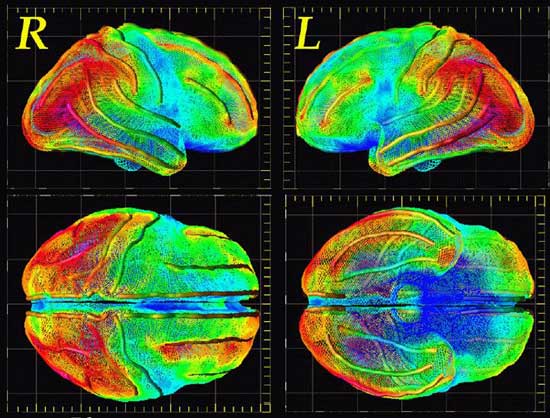
Looking at images is a common diagnostic tool in medicine.

https://docs.uabgrid.uab.edu/w/images/3/3b/Neuroimaging.jpg
Available from http://www.effmis.eu/LinkClick.aspx?fileticket=2B8XzMhPKzY%3D&tabid=153&mid=822. Accessed on 18 August 2014
I have no idea what the different coloured areas in the above scanned image (available from https://docs.uabgrid.uab.edu/w/images/3/3b/Neuroimaging.jpg) mean; that is not the point. The important point is that SOMEONE does and that is why I chose this image. We should look at visual culture in its widest context; in the day to uses for visual media as well as their purely artistic manifestation.

Now consider this image of the Astra Zeneca (AZN) share price movement, taken on 18 August 2014 courtesy of TD Direct Investing:


This image performs a similar function to the one above but this time in graph form: I am looking for information as to whether now is a good time to buy this share. In this case I do understand better what is presented. The main graph shows an erratic trend of share price from which little can be elicited (AZN was the subject of a possible takeover in May 2014 by Pfizer, hence the spike in share price) other than that the price has decreased recently. 

A useful signal is that the 50 day moving average (red line) is above the 20 day MV line (orange). Many analysts will view this as a negative signal that the share price is heading downwards. The relative strength Indicator (RSI) in the middle is a gauge as to whether the stock is oversold or not - typically a reading of 30 or below is viewed as a buy signal. Lastly the Moving Average Convergence Divergence (MACD) indicates negatively, as the lines are below 0.

This information is all gleaned from looking at the graphs. The information is slightly contradictory (a common criticism of charting techniques) but shows how important visual techniques can be for investing.

Observing 


http://thumbs.dreamstime.com/x/child-observing-butterfly-8906266.jpg
A boy observes a butterfly - available from http://thumbs.dreamstime.com/x/child-observing-butterfly-8906266.jpg. Accessed on 18 August 2014
The key difference between observing and looking is that the former has no preconditions. Looking at something implies that we are seeking something that we can use either to enhance our understanding of what we already know or for the advantage of ourselves (as in the graph) or others (as in the brain scan), whereas observing implies we have less understanding of what we are looking at; we have less expectation. 


The boy viewing the butterfly is a perfect example of this. He is using a magnifying glass to see the insect in more detail, trying to understand what it is doing on the flower and what it will do next.
A punter at Bath races in June 2012
 I took the above image at Bath races. It shows a punter watchin the action on the course. The punter is observing, he has an interest but can do nothing with the information he is eliciting; he cannot use the information to his advantage.

Surveillance
  
Surveillance is different from the other two. This is Foucault's Panopticism - a world wehre the visual advantage of some is used to control, manage or supervise the activities of others. Foucault's analysis is essentially negative as it focusses on humans surveying the behaviour of other people but surveillance can be positive as in products that detect forest fires early:


This is the positive side of surveillance - a modern version of the disciplinary project described by Foucault. I chose this example to show that surveillance can be positive.

Gatso speed camera.
Forest fire surveillance system Available from http://www.effmis.eu/LinkClick.aspx?fileticket=2B8XzMhPKzY%3D&tabid=153&mid=822. Accessed on 19 August
A more controlling use of surveillance techniques. The Gatso camera captures images from vehicles and records those that exceed the speed limit by means of timing how long it takes to pass through a measured distance on the road. The information is used to identify the vehicle and then a Notice Of Intended Prosecution is sent to the vehicle owner. I use this example to identify how surveillance is used in practice.