Showing posts with label Part 3: Of Signs and Symbols. Show all posts

Friday, 20 June 2014

Reflections on Chapter 3

When reviewing the course notes, I thought this chapter would be one that I would find particularly interesting. I had read a summary of Barthes' theories in Visual Culture, and was looking forward to reading in more detail.

I have also read more widely during this part of the course, with special reference to chapters on photography. These have particular relevance to the Assignment as photography features highly in advertising. 

The first project was a sort of practice Assignment: annotating a couple of advertisements. This got me reading more widely into some graphic design theory: Fibonacci sequences, looking left to right, that I used briefly in the Assignment. These articles presented a different take on advertising: written by practitioners for practitioners and in a way 'taking for granted' (indeed deliberately enhancing) the manipulative messages that Barthes and others highlight in their treatises. It is important to remember that many people's livelihoods depend on advertising; it is their job to make us view our world in controlled ways. That is an integral part of modern consumerism. Barthes and others help us acknowledge and understand the visual influences that are aimed at our subconscious; where I feel they stray too far at times is an implication that those influences are by definition malevolent - a sort of insidious establishment based impact of a capitalist based society. Not all advertising is bad.

The project on structuralist analysis of two paintings helped to formulate an approach that I used for the first part of the Assignment, using the concepts of form, medium, allusion and purpose.

As well as a habit of using different terminology for the same thing, Barthes often uses phrases that challenge the reader to understand his meaning. Such is the passage that "meaning is always there to present the form; the form is always there to outdistance the meaning". I found an interesting montage by John Heartfield to annotate for the project.

The Death of the Author and Deconstruction are challenging topics, both to understand and to apply to Visual Culture. Foucault's essay takes a fairly extreme view of depersonalisation; too far in my view as it almost defies anyone to suggest new theories or concepts as the author would have neither acknowledgement nor copyright over those ideas. I used work from Banksy and Cindy Sherman on the associated project. I used the deconstruction concepts by comparing two covers of The Economist.

I enjoyed writing the Assignment. Unlike previous Assignments, I had a good idea of what I wanted to use well beforehand, and researched source documents in advance. Off course reading on the internet and Photography: A Critical Introduction provided material and analysis; many of the references are not actually academic research but reflect the us to advertising in practice as discussed above. Late on, I changed my mind as to which image to use as wanted to discuss gender issues (the first choice was a financial services advertisement).

1,500 words (even excluding direct quotations) is quite short for an essay on this topic. I could easily have written 5,000 words as had to skim over some important concepts such as paradigmatic analysis and Hall's theories of encoding/decoding. These are both very useful topics to take forward into further study in future photography modules.

One recurring themes of this course to date is the number of French writers. It is perhaps no coincidence as France has a very strong philosophical background; there is a history of holistic analysis as opposed to Anglo-Saxon tendencies to analyse everything. Visual Culture suits wider thinking, which doubtless explains why so many French writers are featured in the course. Their works are not always easy reading. That is not down to the translation but to commonalities in being verbose; using duplicate terminology for the same concept; and repeating themselves. I dislike of writing that is not clear, as there is a suspicion that it is not clear for a reason; that the author wishes to present his ideas as being rather more enlightening that perhaps is justified.


Sunday, 11 May 2014

Deconstruction

For this project, we are asked to read the essay by Jacques Derrida and then do some further research into Deconstruction.

As a start, I wished to make sense of Derrida's famous assertion that: 'il n'ya pas de hors' texte'. The course notes suggest there are alternative meanings to this statement.

The literal Engluish translation is: 'there is nothing outside text'. Derrida later reformulated to “Il n’y a pas de hors contexte,” or “There is nothing outside of context”. Bryce (2011) expands thus:

"As [Darrida] later clarified, the meaning of a text must be situated within a context that includes competence in the language of the text including its grammar and vocabulary as used in the epoch in which it was written, rhetorical uses of the language, the history of the language itself, and knowledge of the history of the society in which the language is/was used."
This is interesting as it rather goes against the ideas of Foucault and Barthes that were the subject of the last project. They viewed that the writer was a mere scriptor, a sort of messenger, and that the message should be seen in complete isolation from the scriptor.

In French books the hors-texte is where all the prefatory, introductory material. By denying there was such a thing, Derrida emphasises that these parts of the text are actually an integral part of the whole - you might say there is no hors texte. (Valentine, 1994) This makes a great deal more sense.

Some further reading included Chandler's Semiotics for Beginners. This article helps us understand Derrida in simple terms. The key is that texts (or images) do not 'mean what they say'. Contradictions alway exist and "searching for inexplicit oppositions can reveal what is being excluded." (Chandler). Derrida made much of binary opposition, a pair of related terms that are opposite in meaning: homosexuality and heterosexuality, for example. Key concepts of a text depend on unstated oppositional relations to absent signifiers.

This seems to be saying no more than to be aware of what is unsaid in a text: "what is conspicious by its absence". This in turn leads on to paradigmatic analysis, which:

"involves comparing and contrasting each of the signifiers present in the text with absent signifiers which in similar circumstances might have been chosen, and considering the significance of the choices made." (Chandler)
I take two contrasting front page images from The Economist to show this in practice:


The first image is for the issue May 17-23, the second April 19-25. Anyone who does not live in a cave will be familiar with the news stories behind the allegories, but from a visual culture point of view, what is interesting is how they are visualised, and, specifically for this project what is omitted in each in favour of what is included.

If we take the first, we can see the following:
  • the common people characterised similarly to a Brueghel painting (in my ignorance, this may be a montage based on an actual painting, I just cannot identify it). They are constrained, bullied, beaten, mostly in a state of undress, being done to rather than controlling;
  • Political leaders shown imprisoned: Merkel is hanging upside down; Cameron on a pyre; Hollande in the stocks (with a crash helmet as a reminder of his affair with Julie Gayet exposed early in 2014);
  • Signs to polling stations in different languages;
  • Several anti European politicians playing mischief (Farage lighting the pyre beneath Cameron, Wilders drumming in the bottom right behind a 'Non' sign, Beppe Grillo acting as a comedian) or triumphantly riding, as in case of Le Pen at the bottom.
Other allusions to current euro concerns: the grim reaper holding an euro currency logo, a flag of the Ukraine, for example

So the montage is all about the problems besetting the EU and the distinct possibility of significant anti EU voting in the forthcoming election as demonstrated by leading players.

So what is missing, the absent signifiers?:

A map - typically a diagrammatic showing of how the continent might vote;
Any kind of optimistic signifiers. It is all darkness and negativity

In a sense the absent signifiers simply emphasise the message from those that are present.

If we look at the second image, there are no personalities included; instead the map of Russia is carefully drawn to resemble the front of a bear, its mouth open ready to devour eastern Ukraine. Crimea is already in the bear's stomach.

The allusion is clear: The big neighbour to the east stands ready to take over that part of Ukraine that is more pro Russia. But the most notable absence (in contrast to the montage) is any people; Russia is portrayed as the amorphous monolithic state devouring a portion of a neighbour. Perhaps surprisingly in light of his bullish statements on the issue, Russia's President Putin is absent from the image. As with the montage, the absent signifier accentuates what is in this case a nationalistic rather than personality based message.


References:

Bryce (2011) “There is Nothing Outside of the Text” Available from http://www.brycerich.com/2011/02/there-is-nothing-outside-of-the-text.html. Accessed on 7 May 2014

Chandler Semiotics for Beginners Available from http://users.aber.ac.uk/dgc/Documents/S4B/sem-gloss.html#D Accessed on 7 May 2014

Valentine (1994) Sticky Transfers in Grabes (ed.) (1994) Aesthetics and Contemporary Discourse

Tuesday, 6 May 2014

Author? What Author?

For this project, the work of two artists whose work derives from or may better be explained by the concepts enunciated by the articles denunciating authorship by Foucault and Barthes are are to be reviewed, and the following questions addressed:
  •  If the birth of the reader is at the expense of the author, is there still any of Benjamin's aura left?;
  • Does any of this explain or validate the unregulated nature of the internet?;
  • Does this invalidate the interest in the artist's or creator's intent at the time of making?
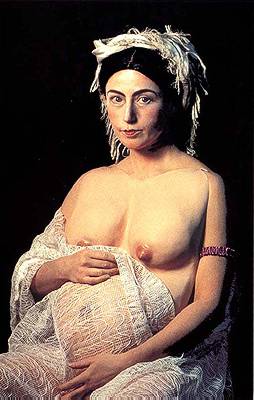
The notes suggest works by Levine and Sherman or find another artist. I chose works by Banksy and Sherman, shown below together with the original works on which they are based:

http://farm3.static.flickr.com/2672/3689960442_19d5fa5dd2.jpg
Banksy, The Flight to Egypt, 2009

http://www.chinaoilpaintinggallery.com/oilpainting/Claude-Lorrain/Landscape-with-the-Rest-on-the-Flight-into-Egypt.jpg
Claude Lorrain, Flight into Egypt, 1666


http://photos1.blogger.com/img/286/2511/400/sherman_un205_lg.jpg
Cindy Sherman, Untitled #205, 1989

Click!
Raphael, La Fornorina, 1518-19

Banksy has cult status as a secretive artist who specialises in graffiti, and, as in this case, a form of appropriation art.

Sherman is best known for photographing herself but not is a self-portrait style. Instead, she dresses up and/or takes on alternative personae. In this photographic allegory of Raphael's painting La Fornorina, Sherman dons thick make up, false breasts and stomach. She wears cheap curtain material instead of diaphanous fabric (Kimberley, undated).

Both artists add humour with their appropriations. Banksy's is as much a play on the words as a work of art; Sherman adds the humour with her slightly exasperated expression and direct stare forwards in contrast with Raphael's original: his young female subject looks to the right and wears an innocent expression. 
 
If the birth of the reader is at the expense of the author, is there still any of Benjamin's aura left?

Benjamin considered that the 'aura' of a work of art was lost in 'the age of mechanical production' for two reasons: the possibility of multiple reproduction; and that the work of art could be considered out of its previously restricted existence. A viewer can appreciate a copy of a work of art in his own sitting room, for example.

It is perhaps only a continuum of the same argument to acknowledge that an appropriated work of art takes away the aura. Indeed, quite aside from consideration of the particular examples in this project, it must be the case that divorcing a 'discourse' (to use Barthes' word, we can substitute 'work of art' here) from its author (painter, photographer, sculptor et al.) must mean there is no aura left, as we are merely looking at the structure of the work of art; an 'author free analysis' makes no reference to the how, why, when of its creation.

The agenda of Benjamin and Barthes are not dissimilar: they wish to empower the viewer (reader) and remove some of the 'aura' of the academic industry (the need to attribute, the over academisation, the long-winded and arcane analyses) that surrounds the art world. The ideas and practices of Sherman and Banksy help us do this by their witty (some might say disrepective) and down to earth representations. Banksy helps the Foucault argument by his avowed anonymity.
  
Does any of this explain or validate the unregulated nature of the internet?

The internet has further accentuated the effects of the 'mechanical reproduction' alluded to by Benjamin. We can view works of art on a screen in seconds, download them and include them in our projects for Open College of the Arts courses. We can view (sometimes listen) to what the contemporary artist thinks of his or her work, read the views of many experts on those who worked long before such easy access to information was thinkable. 

Does it explain? In short, no. The technology preceded the effect. The internet came about form the desire of the US Government to link networks and thus to access information more readily without further manipulation. The extension of it to academia was almost bound to happen as it allowed much simpler access to a wealth of material. 

It is not quite correct to say the internet is unregulated. Some societies ban (or seek to ban, as in the recent attempts of Turkey's President Erdogan to ban YouTube and Twitter) access to part or all of the internet, some effect it by not allowing the necessary hardware (North Korea, for example). Schools will ban access to chat or porn sites by use of firewalls. Where it is more or less unregulated is in the area of downloading material, and thereby potentially breaching copyright. 

There is a dialectic between the democratisation of information - making material available easily and cheaply to as many people as possible - and the rights, (needs) of those who create them to receive reward and acknowledgement. The problem with complete de-regulation, complete socialisation of the information world is that there is no incentive to create original thought, action or deed. We see this in the musical world, where the rise in boy bands and talent shows has been concomitant with the difficulty in maintaining copyright to work , to get rewarded for the copies sold. Why create original work when you can make it singing cover versions of old songs?

Does this invalidate the interest in the artist's or creator's intent at the time of making?

Slightly challenging to understand the question here. What does "this" refer to? Are we referring to the intent of the original artist (Raphael, Lorrain) or the modern one (Sherman, Banksy)? I think the question is aiming at whether the 'internet effect' to give it a contextual epithet, invalidates the interest shown in the works of Sheramn or Banksy. If so, I would say the answer is no. These two artists have benefitted from the promulgation of their work on the internet; their witty takes are in tune with current Zeitgeist of informality and less respect for so-called experts.


References: 


Kimberley (undated) Cindy Sherman: Her “History Portrait” Series as Post-Modern Parody Available from http://breadandcircusnetwork.wordpress.com/2007/07/29/cindy-sherman-her-%E2%80%9Chistory-portrait%E2%80%9D-series-as-post-modern-parody/ Accessed on 4 May 2014


Sunday, 4 May 2014

The Death of the Author by Roland Barthes 1967

This text was downloaded from www.tbook.constantvzw.org/wp-content/death_authorbarthes.pdf.

Barthes' case is similar to that of Foucault. He notes that the concept of authorship is a relatively modern one, arising in Middle Ages. It is part of capitalist ideology that the author's person is important:
"The author still rules in manuals of literary history, in biographies of writers, in magazine interviews, and even in the awareness of literary men, anxious to unite, by their private journals, their person and their work; the image of literature to be found in contemporary culture is tyrannically centered on the author, his person, his history, his tastes, his passions."
Certain writers have attempted to debunk the concept of authorship - Barthes quotes Mallarme and Proust -  then points out that linguistics has dealt the final blow by 
"showing that utterance in its entirety is a void process, which functions perfectly without requiring to be filled by the person of the interlocutors: linguistically, the author is never anything more than the man who writes...."
Thus Barthes lays out his structuralist credentials - explanation is all in the form of the words, no more is needed. The author cannot be seen as pre existing his work:
"Quite the contrary, the modern writer (scriptor) is born simultaneously with his text; he is in no way supplied with a being which precedes or transcends his writing, he is in no way the subject of which his book is the predicate; there is no other time than that of the utterance, and every text is eternally written here and now."
Barthes cites two corollaries of the demise of the author:
  •  the end of the critic. There can be no signification of attribution of a text if the writer's role is simply to translate a 'readymade dictionary' of lexicon;
  • the promotion of the reader - writing must be restored by 'reversing its myth': "the birth of the reader must be ransomed by the death of the author"
Barthes strikes a chord for those who resist the culture of celebrity. It is an irony of the artistic world that a pursuit which is aimed at the production of works to be admired is prone to the culture of celebrity. Once an artist (or a writer for that matter, "It's the next Dan Brown, it must be good") becomes well-known, there is a tendency almost to deify anything else he or she produces (allegorically described by Craig Brown's take on Tracey Emin's exhibition in My Turd).  This holds true as well for academia - ironically, this essay is undoubtedly read far more widely than it might be if it were written by another author. 

Moreover, from a Marxist perspective, the “author”  is a modern invention, derived from capitalist ideology that granted importance to the author’s person that was part of the wider system of ownership, property and privilege.

The main criticism of this approach is the lack of contextuality - if you see nothing but the words or the images you miss out on the richness of how and why they came about. You are left only with the output, but to understand a piece of work, one needs to understand the inputs, the whys, hows and wherefores. A simple example is Sarah Lucas's work in Assignment 2. She points out that she used simple props to demonstrate her message because she had no money to do anything else; the message cannot be entirely divorced from its context otherwise something is lost in the message itself.

It is interesting also to note how Barthes never mentions females: the writers and the readers are assumed all to be male... 

What is an Author? by Michel Foucault

This article is taken from Art in Theory 1900-2000 pp 949-953

Foucault contends that the author's name is more than an element in a discourse. It performs a classificatory function allowing relationships between texts. There is a feeling of  homogeneity and characterization. A discourse containing an author's name must be received in a certain mode and afforded a certain status.

So discourses are endowed with 'author-function' while others like a private letter or a contract, do not. 

Foucault identifies two Characteristics of 'author-function' in discourses:
  •  objects of appropriation - historically penal. Authorship arose with being subject to punishment although Foucault adduces no evidence for this claim;
  • differentiation in author-function between types of discourse. Scientific papers in Middle Ages were typically validated only when marked with name of author, whereas the 'ancientness' of literary discourses was sufficient to guarantee status, though this changed in 17th/18t century
We are accustomed to endowing authors with signification:
"...as soon as he speaks, meaning begins to proliferate, to proliferate indefinitely."
Foucault argues this is mistaken, that in fact the author is no more than a means to choose, to classify, to eliminate, he is an impediment to free circulation, manipulation and composition. 

He does acknowledge that a completely free state is 'pure romanticism', there will be a post 'author-function' constraint system, without enunciating what. It would be a world where discourses develop in an 'anonymity of a murmur'. We would no longer be interested in claims of authorship, of concerning ourselves with authenticity, but with a more objective analysis of the uses to which the discourse may be put, and behind it all, it would make no difference who is speaking. 

This seems rather idealistic. For a start, our academic system is based on authorship, as is our literary system. Authors are rewarded for originality, for profuseness, for individuality, insightfulness, and entertainment. To deny this would be to suffocate discourse. It simply would not be worth turning up. One has only to see the lack of scientific discovery and artistic creativity in socialist societies to understand what would happen. One may ask, if Foucault believes the 'author-function' is dead, why he allows his name at the head of the article?

Saturday, 26 April 2014

Form and meaning for a piece of artwork

Having read the article by Barthes, the project is to annotate an artwork illustrating my thoughts on the following passage taken from Myth Today:
"The meaning is always there to present the form; the form is always there to outdistance the meaning"
Firstly we need to contextualise the statement The extract is from the part of Myth Today where Barthes contends that "myth is a double system" - the point of departure is constituted by the arrival of a meaning; there is a 'turnstile' between the meaning of a signifier and its form. Myth is a form of alibi.

To demonstrate this, I have selected a satirical 1930s montage by the Dadaist John Heartfield, Hurrah, the Butter's Finished. 

The photomontage was published in the leftist weekly Worker's Illustrated Newspaper [Arbeiter Illustrierte Zeitung], a publication aimed at advancing the political education of workers (GHDI, undated). The title is a parody of a speech made by Hermann Göring, an excerpt of which is included at the foot of the photomontage and translates as:
 “Ore has always made an empire strong, butter and lard have made a country fat at most.”
Göring wished to increase the productive capacity of the German war machine and used the comparison to exhort his fellow countrymen to eschew home comforts in favour of the country's rearmament process. The montage is of a 'typical' German family and is annotated here.


Anti-Fascist Imagery:
John Heartfield - Hurrah, the Butter's Finished, 1935

References:

GDHI (undated) Anti-Fascist Imagery: "Hurrah, the Butter is Gone!" (December 19, 1935)Available from http://ghdi.ghi-dc.org/sub_image.cfm?image_id=1929 Accessed on 26 April 2014

Wednesday, 23 April 2014

Myth Today by Roland Barthes

We are asked to read Myth Today and consider three related tasks:
  • Look up who Monou Drouet was. Why does Barthes cite her?;
  • With reference to roses and black pebbles and find elements within a couple of images that you know that signify passions, emotions or other objects of events;
  • Consider phyis and anti physis and find an example of the image that changes the real into a message
These are covered in the notes at the end.

Before reading the chapter in the course reader, let us summarize the Semiotics chapter by Howells and Negreiros (2012). read this before starting course, now rereading as refresher.

Semiotics originated with the Swiss linguist de Saussure, who devised the 'lexicon of signification', a group of terms comprising the 'signifier' (that which stands for something else), the 'signified' (the idea it stands for) and the 'sign' (the union of the two).

Example is D-O-G means furry quadruped with cold, wet nose. In French it would be C-H-I-E-N.

The key is that nothing naturally means anything and therefore meaning must be cultural. There is nothing God given that DOG means a four footed domestic animal, for example. Sign is arbitrary, else there would be only one language.

(A good example would be secret code - the sign is to be secret in order that only certain people can know what the signifier stands for).

Saussure concentrated on written and spoken language. His early work on semiotics sowed seeds for extension into many areas beyond the literary, notably anthropology and psychoanalysis. Barthes extended semiotics into visual and popular culture.

We live in a more semiotic world than we realise: H&N give examples of wearing a tie to an interview (shows we are serious about the job), the tie needs to be right as well - not too garish or heavily patterned (colours are semiotic as well, take pink as very feminine for example). H&N point out the power of car logos too - the propeller badge of BMW 'oozes expense and sophistication'. Mercedes Benz is recognizable by 3 pointed star, but add one stroke and it becomes CND.

Because sign is arbitrary, relationship can change over time. H&N give the example of the Eiffel Tower; today it is the icon of Paris, but when built was viewed as an ugly eyesore. Blackpool Tower was modelled on Eiffel but has entirely different connotations as the icon for a resort popular with northern English working classes as opposed to the chic sophistication of Paris. "The signifier is an empty vessel into which cultural meaning is poured to imbue it with meaning."

So let us now turn to Myth Today. 

Barthes opens with this simple definition: myth is a type of speech. At first sight, this appears disarming, but actually it is a necessary statement because Barthes is extending de Saussure's lexicon from words to images.

He continues that myth is a system of communication, that it is a message.

Everything can be a myth. Barthes points out that "a tree is a tree", but as expressed by Minou Drouet, it is more. (see note 1). Drouet imbues the tree with meaning - she anthropomorphises (leaves become 'green locks', branches swaying in the wind are 'living hands') and personalises it ('knowing like me the voices of silence'; 'the tree that I love').

Barthes emphasises the importance of 'sign' as the 'associative total' of the signifier and the signified. A bunch of roses may be used to signify passion, but 'roses' and 'passion' existed before their unification into a sign. A black pebble can be a signifier in many ways, but if it is imbued with a definite signified (say a death sentence) it will become a sign. (see note 2 for an example of images containing signified passions).

The most important theoretical part of Barthes' essay is where he extends Saussure's semiological system from language to pictures. He does this literally by the creation of a metalanguage: 'a second language in which one talks about the first' (termed the language-object). Slightly confusingly, Barthes uses myth, perhaps best described as the 'sum of signs', as a synonym for metalanguage.

So we have a flow from language object to myth or metalanguage. The sign resulting from the first becomes the signifier in the second. Barthes spatializes the relationship thus:


Barthes uses metalanguage in order to extend semiology beyond language; writing and pictures may be treated equally; they are both signs. He later uses the terms form, concept and signification instead of (respectively) signifier, signified and sign in the mythical system.

The essay continues with two examples, one taken from Latin grammar, the second the following cover from Paris Match:

Available from www.visuality.org/parismatch/barthesanalysis.htm Accessed 20 April 2014
Barthes writes:

"I am at the barber’s, and copy of Paris-Match is offered to me. On the cover, a young Negro in a French uniform is saluting, with his eyes uplifted, probably fixed on a fold of the tricolour. All this is the meaning of the picture. But whether naively or not, I see very well what it signifies to me : that France is a great Empire, that all her sons, without any colour discrimination, faithfully serve under the flag, and that there is no better answer to the detractors of an alleged colonialism than the zeal shown by this Negro in serving his so-called oppressors ...”

The most complex part of the essay is the section on the form and the concept. Barthes recognizes the dialectic between the sign as recognized at the first level being the signifier (form) of the second:

"...a signification is already built, and could very well be self-sufficient if myth did not suddenly take hold of it and did not turn it suddenly into an empty. parastical form."

The meaning is complete at the first level, but when it becomes form "it empties itself". But "form does not suppress the meaning, it only impoverishes it." There is a constant game of hide and seek between meaning and form that defines myth.

Unlike the form, concept is not abstract - "a whole new history implanted in the myth". Myth is a double system: "its point of departure is constituted by the arrival of a meaning".

Barthes reveals his political leanings in the final section: Myth is depoliticized speech. He sees that myth has "the task of giving historical intention a natural justification", exactly the process of bourgeois ideology. He sees that "our (i.e capitalist) society" uses "mythical significations" because it suits the bourgeoisie to be in the background, not to be named. It achieves this by moving from anti physis - the refusal to engage with the real world - to pseudo physis – an appearance of a real world which is actually a world of signs (Robinson, 2011) (see note 3).
 

The world supplies to myth an historical reality; myth in return presents a natural image of this reality. In the case of the Negro, myth does not seek to reject imperialism, rather the fabricated quality of colonialism.

"Myth does not deny things, on the contrary, its function is to talk about them; simply, it purifies them, it makes them innocent, it gives them a natural and eternal justification, it gives them a clarity which is not that of an explanation but that of a statement of fact. If I state the fact of French imperiality without explaining it, I am very near to finding that it is natural and goes without saying: I am reassured."

This is powerful and persuasive writing. The concept of "goes without saying" is viewed by Howells and Negreiros (ibid, p123) as the most important of all mythologies to the student of visual culture. They point out that Barthes is part of the intellectual scene that expands bourgeois values to conventional middle-class respectability, typified by smug, reactionary lack of thinking. 

How does Barthes' theory seem nowadays? I would say there are four problems with his analysis:
  1. It is isolationist to use the expression I used in a previous post. There is an arrogant overtone that somehow his mythology is the theory of visual culture;
  2. It is overly complicated - Barthes hardly needs to construct a theoretical structure around his rants against bourgeois ideology. He adds terminology for the sake of it, and sometimes confusingly so. The semiotics are aimed to give the polemics a pseudo scientific and therefore intellectually more robust appearance;
  3. He sees what he wants to see - his examples are selective;
  4. That mythology is not restricted to bourgeois attitudes but is present in all societies. History has itself been manipulated in 1984 year zero style by societies that would see themselves as the antithesis of bourgeois culture. A recent example was the removal of the uncle of Kim Jong-un - the leader of North Korea - from pictures (BBC, 2013). All establishments use mythology in order to control their subjects, from nation states to religions to sects. 
But let that not diminish the significance of Barthes' theory - it does provide a rationale and a methodology for us to look critically at the messages being issues by our societies, and a way to decode the visual messages that we receive.


ADDITIONAL NOTES FOR THE TASKS IDENTIFIED

Note 1: Minou Drouet's tree. Drouet was quite an enigmatic character (Dawn.com, 2008). She was only eight when her poem came to public attention. The media and French opinion was split in two as to whether it was Minou or her mother who penned the poem. The dispute was resolved only when the child was put in a locked room with no outside communication and asked to write a poem on Paris sky. 25 minutes later she revealed a poem that brought the chairman of the poet's association to tears. Her authenticity as a poet was not in doubt.

Drouet's poem is set out below.


“Tree that I Love”
by Minou Drouet

Tree that I love,
tree in my likeness,
so heavy with music
under the wind’s fingers
that turn your pages
like a fairy tale,
tree
knowing like me
the voices of silence
that sways
the depth of your green locks
the quiver of your living hands
tree
that I love
my all alone
lost like me
lost in the sky
lost in the mud
lacquered in the dancing light
by the rain
tree
echo of wind’s grief
and birds’ joy
tree undressed by winter
for the first time I watch you.

There are many poems that Barthes could have chosen to demonstrate the point that material objects can have meaning laden upon them. I thought of this poem from Walter de la Mare:

As I was walking,
Thyme sweet to my nose,
Green grasshoppers talking,
Rose rivalling rose:
And wing, like amber,
Dispread in light,
As from bush to bush
Linnet took flight:
Master Rabbit I saw
In the shadow-rimmed mouth
Of his sandy cavern,
Looking out to the South.
'Twas dew-tide coming;
The turf was sweet
To nostril, curved tooth,
And wool-soft feet.
Sun was in West;
Crystal in beam
Of its golden shower
Did his round eye gleam.
Lank human was I,
And a foe, poor soul—
Snowy flit of a scut,
He was into his hole,
And—stamp, stamp, stamp!
Through dim labyrinths clear,
The whole world darkened,
A murderer near.

Walter de la Mare

But Barthes was French so he was likely to think first of a French poet. He may well have chosen Drouet's simply because the controversy over the authorship of her work was national news, so it came to his mind.

Note 2: Elements in images that signify passions emotions etc.

I am old enough to recall the Milk Tray ads, in which a handsome man performs James Bond style acts in order to deliver a box of chocolates to his loved one. The catchphrase was "and all because the lady loves Milk Tray". The chocolates are meant as the signifier but just in case the audience needs a nudge to understand what is meant, the man performing acts of derring do in order to deliver said chocolates acts as a further signifier; it may be argued that neither acts in isolation - it is 'Milk Tray Man' (MTM) with chocolates that is the signifier. In the same way that Barthes' black pebble my be weighted with a definite signified, so the chocolates are weighted by the presence of MTM.

The milk-tray-man Available from http://www.virginmedia.com/images/the-milk-tray-man.jpg

Let's take another example from today's (19 April 2014) news, just to prove that you should need to go far to find examples of emotions within images 


BBC News 19 April 2014. Available from http://www.bbc.co.uk/news/uk-27085857
Human culture is such that one would guess that anyone from any part of the world for most of recent human history would infer most of all of the following from the above image, without even knowing who the woman on the left is:
  • She is famous - many people on the right (few of whom are themselves recognisable) trying to glimpse one on the left;
  • Everyone is happy, even adoring - smiling, trying to touch hands, signifying their adoration for the woman;
  • The people towards the back are using cameras, iPads, smartphones etc to capture their own "I was there" moment. The number of cameras etc signifies that the woman is popular and famous, and taking her image presents no threat to them, indeed quite the contrary;
  • The woman is appreciative, relaxed and welcoming of the attention - she is engaging in an informal way;
  • The reactions are spontaneous and warm
This is therefore quite a complex image. The signifiers are many: smiling faces, an unstructured but well-behaved crowd; cameras; outstretched hands; one woman facing right, many people looking towards her. Joy and adoration may be said to be signified, the two elements coming together in the sign captured by the image.
We can notice as well that the camera operator has used a shallow depth of field, thus blurring people in near and far distance and emphasising the importance of the woman by ensuring she is in sharp focus and well lit, thus increasing the impact of the sign.

Note 3: Barthes uses the terms anti-physis and pseudo physis in his analysis of capitalism (Robinson, ibid). He believes the bourgeoisie does not wish to be named, especially at the level of ideology and everyday life. This refusal occurs by moving from anti-physis to pseudo physis, i.e. moving from a refusal to engage with the real world to an appearance of the real world which is actually a world of signs. Pseudo physis denies to people their ability to remake the world by setting narrow limits on how people are to live so as not to upset the dominant order.


The notes suggest looking at this painting: Portrait of Stakhanov by Leonid Kotliarov. 


Stakhanov was an early hero of the Soviet socialist revolution. He became a celebrity in 1935 as part of the movement intended to increase worker productivity and demonstrate the superiority of socialism (Wikipedia). Stakhanov reportedly mined 227 tonnes of coal in one shift on 19 September 1935, although it later transpired he may have been assisted in what was an event stage managed by the Communist Party (New York Times, 1985).

In Barthesian terms, the real image of the miner (the anti-physis) metamorphoses into an ideological statement that the socialist system is best (the pseudo physis).


http://www.thirteen.org/13pressroom/files/2014/06/Migrant-Mother.jpg
Migrant Mother Dorothea Lange, 1934

Virtually any image that seeks to provide a message beyond the real, beyond the mere representation, can be viewed in this way. One of my favourite images is by Dorothea Lange:
Lange passed the woman on her way home from a long assignment, then turned back to take the photograph. The woman asked Lange no questions as the photographer took five exposures (Clark, 1997, p151).Clarke continues:

"The woman is used purely as a subject, She is appropriated within a symbolic framework of significance as declared and defined by Lange....The woman is viewed as a symbol larger then the actuality in which she exists."

The image is composed perfectly: the mother at the centre, looking away from the camera, the children in the background (Clarke see symbolism with Madonna and Child). It is the woman's expression that provides the defining message: a vacant yet almost defiant stare. The real image stands for something more profound.

 References:

BBC (2013) http://www.bbc.co.uk/news/world-asia-25295312 Accessed 20 April 2014

Clarke (1997) The Photograph. Oxford University Press, Oxford.
 
Dawn.com (2008) The Curious Case of Minou Drouet Available from http://www.dawn.com/news/840653/the-curious-case-of-minou-drouet Accessed 19 April 2014
 
Robinson (2011) Roland Barthes’s Mythologies: Naturalisation, Politics and everyday life
Available from http://ceasefiremagazine.co.uk/in-theory-barthes-3/ Accessed on 20 April 2014


New York Times (1985) quoted in Wkipedia, Alexy Stakhanov


Wikipedia Alexy Stakhanov Available from http://en.wikipedia.org/wiki/Alexey_Stakhanov Accessed on 23 April 2014

Friday, 18 April 2014

Structuralist analysis


For this project, we asked to do two things:

Find two examples of naturalistic paintings of a particular genre and annotate to discover the the similar conventions of representation; 

Find two examples of portrait photography, one formal, one informal, and annotate them to see what conventions from the formal are observed in the informal and give thoughts on why this may be so.

This is a good example of a fairly challenging project, as not familiar with the conventions on annotation (the link in the study guide is incorrect), and need to understand the conventions of representation. Found these in Wikipedia as follows:

medium - the substance used for the artwork - oil on painting, for example;

format - size and shape of the work, its orientation. Both impact on composition;

allusion - putting something in a different context;

purpose - what is the unique reason for the work, can be motivated or non motivated.

 non- motivated includes the human instinct for balance, rhythmn, harmony; the mysterious; express imagination; ritualistic or symbolic

motivated - communication of an idea; entertainment; political change; art as 'free zone' exploring different cultures and techniques; social enquiry or social causes; healing; propaganda, fitness indicator

For the first part, two well-known 19th century paintings were selected: Hay Wain by Constable, and Fallen Monarchs by William Bliss Baker. These are annotated on this link.

The portraits were selected by searching the internet. I aimed to find two painted at a broadly similar time, settling on Portrait of a Man in a Purple Robe by de Largilliere from about 1700 as a good example of a formal portrait of a worthy,and van Dyck's Portrait of François Langlois from probably early 1630s, annotated on this link.