The first part of this project is to read Panopticism by Michael Foucault from the course reader. The reader omits some paragraphs, so read the entire article on this link
Foucault starts by describing the surveillance process utilised during the Great Plague. He sets out some of the key ingredients of the system: that each street is placed under surveillance by a syndic, who leaves on the pain of death; a permanent registration of all inhabitants of the street; the ultimate power of the magistrate to appoint physicians in charge of treatment of the sick. The plague is met by order:
"It lays down for each individual his place, his body, his disease and his death, his well-being, by means of an omnipresent and omniscient power that subdivides itself in a regular, uninterrupted way even to the ultimate determination of the individual, of what characterises him, of what belongs to him, of what happens to him. Against the plague, which is a mixture, discipline brings into play its power, which is one of analysis."
Foucault contrasts the 'disciplinary project' of the plague with the 'confinement' of the leper, who was 'left to his doom', rejected. Leprosy led to separation, the plague to segmentation. The former was characterised by being marked, the latter by being analysed and distributed.
These two 'projects' - to use Foucault's term - were not incompatible; Foucault sees the coming together during the 19th century: the technique of 'disciplinary partitioning' was applied to many classes of exclusion, of which the leper was the 'symbolic inhabitant: beggars, vagabonds, madmen and the disorderly). Authorities act in double mode: that of binary division and branding (mad/sane; dangerous/harmless etc) and that of coercive assignment (broadly how he is to be controlled).
Foucault sees Bentham's Panopticon as the architectural manifestation of this composition. Based on the idea devised by his brother Samuel of a circular hub at the centre of a compound facilitating managers to oversee the activities of a large workforce, Bentham proposed a model of central overseeing for prison design. The salient feature of Bentham's Panopticon was that power should be 'visible and unverifiable'. The inmate will always be able to see the central tower from where he is being surveyed, yet unverifiable because he must not know whether he is being looked at, but aware that he may be. The disassociation is a perfect opposite:
"...in the peripheric ring, one is totally seen, without ever seeing; in the central tower, one sees everything without ever being seen"
Power is automated and 'disindividualized'.
The Panopticon can also be used as a laboratory. In a section that rather eerily predates the horrors of human experimentation during the Holocaust, Foucault says the Panopticon could be used to experiment with behaviour alteration, training, medicine, different types of punishment and pedagogical experiments. These are considerably less malign than the Nazis' experiments, but the top of a slippery slope.
The Panopticon can also be used as a laboratory. In a section that rather eerily predates the horrors of human experimentation during the Holocaust, Foucault says the Panopticon could be used to experiment with behaviour alteration, training, medicine, different types of punishment and pedagogical experiments. These are considerably less malign than the Nazis' experiments, but the top of a slippery slope.
"Thanks to its mechanisms of observation, [the Panopticon] gains in efficiency and in the ability to penetrate into men's behaviour"Within 150 years, Foucault observes, the disciplinary programme has been transformed. In the first, exceptional, situation, of a plague, society mobilizes and invents a power that is everywhere present and visible. It might be draconian, but the power is understandable to those it affects. By contrast, the Panopticon is:
"a generalizable model of functioning; a way of defining power relations in terms of the everyday life of men."The Panopticon is a 'cruel ingenious cage' used not only to incarcerate, but also to reform, instruct, supervise - it is 'polyvalent'. Power is no longer seen as an external 'heavy rigid constraint' but more subtly functions in the guise of efficiency.
Furthermore, it works on an 'amplified' scale because not only can many people be observed at once, they can also be observed by many: a transparent building in which the exercise of power may be supervised by society as a whole.
Discipline in the Panoptic model is applied more functionally; the model moves from one of exceptional discipline to one of generalized surveillance and the advent of 'the disciplinary society' applicable to many situations. Panopticism was to part to be a 'political anatomy' embracing the relations of discipline. The disciplinary mechanisms would be a network. Here we can see the precursor of the police state in the post war Communist societies.
Many video artists today use themselves as their subject. Think about this in relation to panopticism.
Self portraiture has a long history. Portrait of a Man in a Turban by Jan van Eyck of 1433 may well be the earliest known panel portrait (Wikipedia). Photographers such as Cindy Sherman popularized the concept in the 20th century. The digital age is bound to increase this form of art as the technology (think of selfies on tablets or mobile phones) makes it so much more accessible.
More widely, the
webcam is a popular means to visualize what was not possible before:
action in a distant wildlife park; cheap
communication across the globe, and more salaciously, for adult webcam
'communities' designed for online voyeurism and titillation.
This sort of art merges the three functions of looking, observing and surveillance; webcams in particular 'always there', mostly capturing the most mundane activities. At the most basic level, it is a sort of surveillance - an objective view of what is happening, not necessarily in an authoritarian way but more in terms of curiosity; this can easily move towards observing - where there is more understanding of the subject, and lastly looking, which can easily become voyeurism. One must assume that artists are not encouraging voyeurism so are aiming at viewers who 'observe', who might show a degree of empathy and understanding with the artist.
Find six images in any medium: two that are the result of looking, tow of observing and two of surveillance and explain your choices.
Looking at images is a common diagnostic tool in medicine.
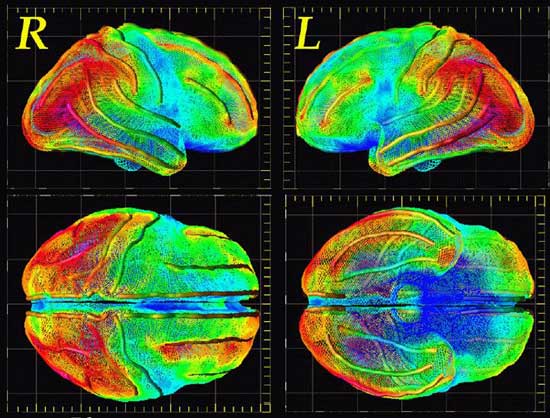 |
| Available from http://www.effmis.eu/LinkClick.aspx?fileticket=2B8XzMhPKzY%3D&tabid=153&mid=822. Accessed on 18 August 2014 |
Now consider this image of the Astra Zeneca (AZN) share price movement, taken on 18 August 2014 courtesy of TD Direct Investing:

This image performs a similar function to the one above but this time in graph form: I am looking for information as to whether now is a good time to buy this share. In this case I do understand better what is presented. The main graph shows an erratic trend of share price from which little can be elicited (AZN was the subject of a possible takeover in May 2014 by Pfizer, hence the spike in share price) other than that the price has decreased recently.
A useful signal is that the 50 day moving average (red line) is above the 20 day MV line (orange). Many analysts will view this as a negative signal that the share price is heading downwards. The relative strength Indicator (RSI) in the middle is a gauge as to whether the stock is oversold or not - typically a reading of 30 or below is viewed as a buy signal. Lastly the Moving Average Convergence Divergence (MACD) indicates negatively, as the lines are below 0.
This information is all gleaned from looking at the graphs. The information is slightly contradictory (a common criticism of charting techniques) but shows how important visual techniques can be for investing.
Observing
 |
| A boy observes a butterfly - available from http://thumbs.dreamstime.com/x/child-observing-butterfly-8906266.jpg. Accessed on 18 August 2014 |
The key difference between observing and looking is that the former has no preconditions. Looking at something implies that we are seeking something that we can use either to enhance our understanding of what we already know or for the advantage of ourselves (as in the graph) or others (as in the brain scan), whereas observing implies we have less understanding of what we are looking at; we have less expectation.
 |
| A punter at Bath races in June 2012 |
Surveillance
Surveillance is different from the other two. This is Foucault's Panopticism - a world wehre the visual advantage of some is used to control, manage or supervise the activities of others. Foucault's analysis is essentially negative as it focusses on humans surveying the behaviour of other people but surveillance can be positive as in products that detect forest fires early:
This is the positive side of surveillance - a modern version of the disciplinary project described by Foucault. I chose this example to show that surveillance can be positive.
A more controlling use of surveillance techniques. The Gatso camera captures images from vehicles and records those that exceed the speed limit by means of timing how long it takes to pass through a measured distance on the road. The information is used to identify the vehicle and then a Notice Of Intended Prosecution is sent to the vehicle owner. I use this example to identify how surveillance is used in practice.
 |
| Gatso speed camera. |
 |
| Forest fire surveillance system Available from http://www.effmis.eu/LinkClick.aspx?fileticket=2B8XzMhPKzY%3D&tabid=153&mid=822. Accessed on 19 August |


